09/29 2026
How to Shoot a Panorama Handheld, Without a Panoramic Head
You don't need an expensive tripod and panoramic head to shoot a 360° panorama. Camera settings, a string-and-weight trick for parallax, and what to avoid.
Spherical panorama Equipment for 360º The best

4K 3
Shooting a panorama handheld, without a panoramic head
Early in their careers, a lot of photographers are captivated by interactive panoramas - the kind that let you look around the space in every direction. This style of shooting is also called a 3D panorama.
Plenty of people want to try panoramic photography, but the internet is full of contradictory information that misleads beginners. One of the persistent web myths is that you first have to buy expensive specialist gear: a tripod and a panoramic head. However keen you were, the enthusiasm cools, and panoramic photography stays a daydream.
Today we'll debunk that myth and show you how to shoot a 3D panorama without a panoramic head
The basics you'll need
- A camera, ideally one with an interchangeable lens.
- If you can, fit a short focal length lens.
- At a push, any consumer camera will do - treat it as practice.
A spherical panorama is, above all, a sequence of shots covering the space around you. For the software to stitch them into a panorama afterwards, you need each frame to overlap the last by 20-30%.

A short focal length lens makes stitching easier, because you need fewer frames.
Beating parallax on your own
Here is how to replace a panoramic head with what you have to hand. You'll need a piece of string and a small weight.
- Tie the string with the weight to the end of the lens.
- Mark the starting point on the ground directly under the weight.
- Shoot your way around the space, making sure the weight neither swings nor drifts away from that point.
As you can see, shooting without specialist equipment is straightforward enough. Done this way, you can produce panoramas of the same quality as you would with a panoramic head.
How to set up your camera for handheld panoramic shooting
Avoid using flash for panoramic work; we'd suggest landscape mode. Perfectionists after the best possible result should shoot in manual. Set the camera up before you start:
- Set the lens to a short focal length
- Switch to manual focus and focus on mid-ground objects
- Switch fully to manual mode
- Set the white balance to suit the weather
- Set the exposure
- Set the aperture to f/8.0-9.0
- Then half-press the shutter button and check the exposure scale
On a DSLR you can do this with the wheel next to the shutter button.
That's your camera ready to shoot. Run through these steps a few times and they stop feeling tedious - for a professional, setting a camera up for panoramic work is a 40-second job. The next step is shooting the frames of the panorama itself, in a full circle.
The main reasons a panorama fails to stitch
Even on your first attempt, the main enemies of panoramic photography can be avoided.
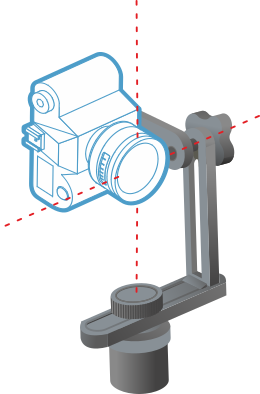
The first and biggest source of stitching errors is parallax. Close your right eye and then your left, one after the other, and you'll notice the object shifts slightly. Exactly the same thing happens when you shoot: foreground objects move relative to the background. To avoid it, you need to rotate the camera around the nodal point rather than around yourself.
That is precisely what panoramic heads are for: they rotate the camera so that parallax never shows up. But with a bit of practice and the right knowledge, you can do without the expensive hardware and rely on your own steadiness and skill.
Improving your panorama
Shooting in clear weather, try increasing the exposure on the frames facing into the sun. Taking several shots of the same frame at different exposures will get rid of blown-out highlights.
Choosing subjects to shoot
Starting out - and especially shooting without a panoramic head - look for scenes with nothing in the immediate foreground. The edge of a forest, open steppe, or the middle of a town square make ideal subjects for your first experiments.
Roughly every third beginner tries to shoot a panorama in their own flat. Failing at it can put someone off the craft for good, which would be a shame. A flat is full of close foreground objects, and every one of them introduces errors into the panorama. Once you've mastered the technique, even shooting your own living room won't give you trouble. For now, though - head outdoors.
Stitching the finished panorama
You can spend the time stitching panoramas yourself, or you can hand the assembly to professionals. When professionals stitch a panorama the quality is noticeably better - and that's when your first steps in panoramic photography start to have some aesthetic point to them.
Publish your finished panorama on TrueVirtualTours and share your work with the people close to you.
Here's to some great moments!
Related articles
Best 360 cameras for virtual tours in 2026
-
 today
todayJohn Smith
-
 02/11 2019
Den-misyo
Roman, links often broken in articles and here on video!
Translated from Russian -
 02/11 2019
Roman Grinev
Thank you, Denis!
Translated from Russian
Indeed, many of the links in the articles on this site were broken. This is due to a change in the system links on the site. Once again I checked all the articles on the site and corrected the links where necessary.
Thank you for helping to make the site better! -
 02/11 2019
Alex
"modal point", ahaha, yes you are a pro))
Translated from Russian